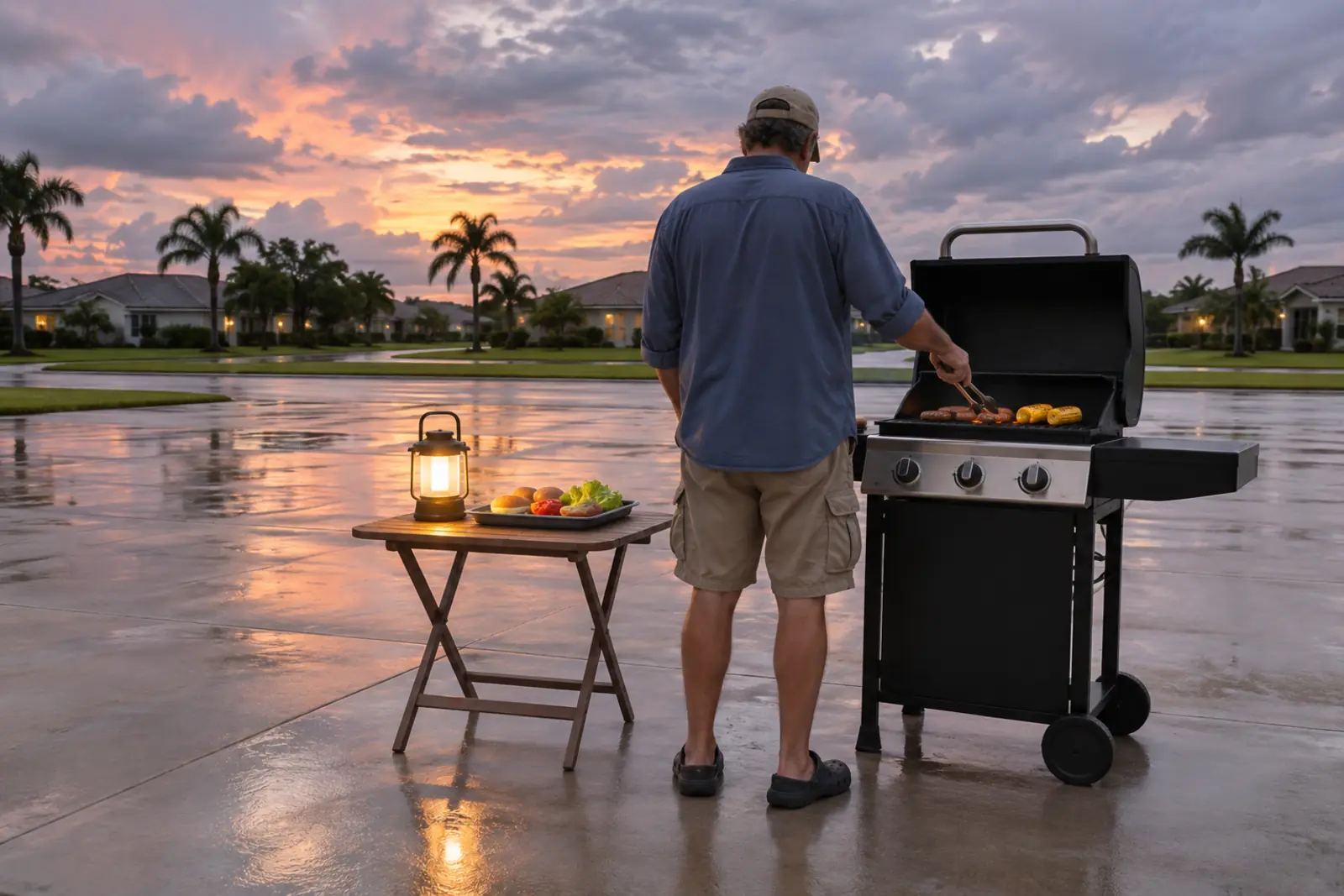
Grilling during hurricane season is safe only outdoors and only when the weather allows it. The Atlantic hurricane season runs from June 1 to November 30. A charcoal or gas grill can cook for a household when the power is out, but never use a charcoal grill, gas grill, camp stove or generator inside a home, garage, carport with walls, enclosed porch or near open windows and doors, because they produce carbon monoxide, an invisible gas that can kill. Before a storm, secure or store the grill so it cannot become a projectile, disconnect propane cylinders and keep them upright outdoors, and stock enough fuel to cook for several days. After a storm, check the grill and gas connections for damage before lighting it, and use a food thermometer to decide what is still safe to cook.
Can you grill during a hurricane?
Not while the storm is passing. Grilling in a hurricane means cooking outdoors in strong wind, flying debris and sometimes flooding, and the only safe place to use a grill is outside, so there is no safe spot to light one until conditions calm down. Cook before the storm arrives, ride out the worst indoors on food that needs no cooking, and light the grill only after the wind has dropped and the area around it is clear of debris.
The same applies to a power outage on a calm day: a grill is a good backup stove, but only in the open, away from the house,, following the manufacturer's instructions.
The carbon monoxide rule
Carbon monoxide poisoning is a well-documented danger after hurricanes, when people turn to grills and generators. The CDC warns never to use a generator, grill, camp stove or other gasoline-, propane-, natural gas- or charcoal-burning device inside a home, basement, garage or camper, or outside near an open window. A garage with the door open is not safe. Neither is a screened lanai attached to the house where fumes can drift inside.
For generators, the CDC advises keeping them outside at least 20 feet from doors, windows and vents. That figure is for generators; for grills, the rule is to stay away from doors, windows and vents, to follow the manufacturer's clearances in the manual, and to follow local fire code (see the condo section below for the multifamily rule).
Symptoms of carbon monoxide poisoning include headache, dizziness, weakness, upset stomach, vomiting, chest pain and confusion. People who are asleep can die before they notice anything. If you suspect poisoning, get everyone into fresh air immediately and call 911. The U.S. Consumer Product Safety Commission recommends battery-operated or battery-backup carbon monoxide alarms on every level of the home and outside sleeping areas, and interconnected alarms so that when one sounds, they all sound. Install them before the season starts and check the batteries regularly. The CDC's guidance on avoiding carbon monoxide poisoning has more detail.
Before the season: what to stock
| Item | Notes |
|---|---|
| Propane cylinders | Keep at least one full spare; refill or exchange early in the season, before demand spikes |
| Charcoal | Store in a sealed, waterproof bin; damp charcoal is nearly useless |
| Chimney starter and long lighter or matches | Lighter fluid is optional; a chimney needs only newspaper |
| Instant-read thermometer with spare batteries | Essential for deciding what food is still safe |
| Appliance thermometers for fridge and freezer | Tell you whether food stayed at 40°F or below during an outage |
| Heavy foil and disposable pans | Cooking and serving with little washing up |
| Coolers and a plan for ice | Ice can be scarce right after a storm |
| Battery or battery-backup CO alarm | Install near sleeping areas |
A pellet grill needs electricity to run its auger and controller. Unless you have a safe power source, a charcoal or gas grill is more dependable during an outage. The guide to choosing a grill or smoker for a coastal climate compares the options, and the guide to smoking meat in heat, humidity and summer storms covers cooking outdoors when the weather is unsettled.
Propane storage before a hurricane
Store propane cylinders upright outdoors, with the valve closed, away from doors and windows, and secured so they cannot tip or blow away. Do not keep them inside the house or in an enclosed garage. If the cylinder is connected to a grill, disconnect it first. Do not use a leaking or dented cylinder.
When a storm is approaching
- Cook down the freezer first. In the days before landfall, grill the most perishable items while you still have power and can refrigerate leftovers.
- Freeze containers of water. They keep the freezer colder longer and become drinking water as they thaw.
- Turn the fridge and freezer to their coldest settings.
- Disconnect the propane cylinder and close the valve.
- Secure or store the grill. Strong winds can turn grills, lids and side tables into dangerous debris. If you bring the grill into a garage or shed for the storm, make sure it is fully cool, the cylinder is removed, and it is not used there.
- Store propane cylinders upright outdoors, away from doors and windows, secured so they cannot tip or blow away. Do not keep them inside the house or in an enclosed garage.
After the storm: before you light anything
- Check the grill for damage, debris and standing water in the firebox or burners.
- Inspect propane hoses, regulators and connections. Brush soapy water on the connections and open the valve; growing bubbles mean a leak. Do not use a leaking or dented cylinder.
- If you smell gas around the house, leave immediately and call 911 or the gas utility from a safe distance.
- Set up the grill outdoors in the open, well away from the house, debris piles, downed power lines and fuel.
- Keep children and pets away from hot surfaces, and never leave a lit grill unattended.
Food safety during a power outage
The USDA advises keeping refrigerator and freezer doors closed as much as possible. A closed refrigerator keeps food cold for about four hours. A full freezer holds its temperature for about 48 hours, and a half-full freezer about 24 hours.
| Food | What to do |
|---|---|
| Meat, poultry, fish, leftovers in the fridge above 40°F for more than 2 hours | Discard |
| Frozen food that still has ice crystals or reads 40°F or below | Can be refrozen or cooked |
| Food that touched floodwater | Discard, except commercially canned goods that are undamaged and properly cleaned |
| Thawed meat that is still cold | Grill it promptly and cook to a safe internal temperature |
Cook thawed meat to the safe minimums in the temperature chart, and remember that in post-storm heat, cooked food should not sit out more than an hour. The hot weather food safety guide explains why.
Cooking well with limited supplies
- Cook in batches and eat right away rather than holding food warm for hours.
- Use foil packets for vegetables, fish and small cuts; they cook quickly and need little cleanup.
- Boil water on a side burner or a pot on the grill if a boil-water notice is in effect.
- Share with neighbors. A large freezer of thawing meat can feed a street if it is cooked safely and promptly; the how much BBQ per person guide helps size portions for a crowd.
- Watch fuel use. A gas grill on high burns through a cylinder far faster than on medium.
Grilling in condos after a storm
Hurricane damage does not suspend the fire code. In multifamily buildings, grills still may not be used on balconies, under overhangs or within 10 feet of the building. Use designated community grill areas if they are safe, or cook at a single-family neighbor's home. The condo grilling rules guide has more.
Frequently Asked Questions
Can I use my grill in the garage during a hurricane?
No. Grills produce carbon monoxide and must never be used in a garage, even with the door open, or in any enclosed or partly enclosed space. Use grills only outdoors, away from doors, windows and vents.
Where should I store propane tanks during a hurricane?
Keep them upright outdoors, away from doors and windows, secured so they cannot tip over or blow away, with valves closed. Do not store propane cylinders inside the home or an enclosed garage.
How long does food last in the freezer without power?
About 48 hours for a full freezer and about 24 hours for a half-full one, if the door stays closed. Food with ice crystals or at 40°F or below can be refrozen or cooked.
Can I cook meat that thawed during a power outage?
Yes, if it is still at 40°F or below or has been above that for less than two hours. Grill it promptly to a safe internal temperature and eat it soon after cooking.
What are the signs of carbon monoxide poisoning?
Headache, dizziness, weakness, nausea or vomiting, chest pain and confusion. Get everyone into fresh air immediately and call 911 if you suspect carbon monoxide exposure.