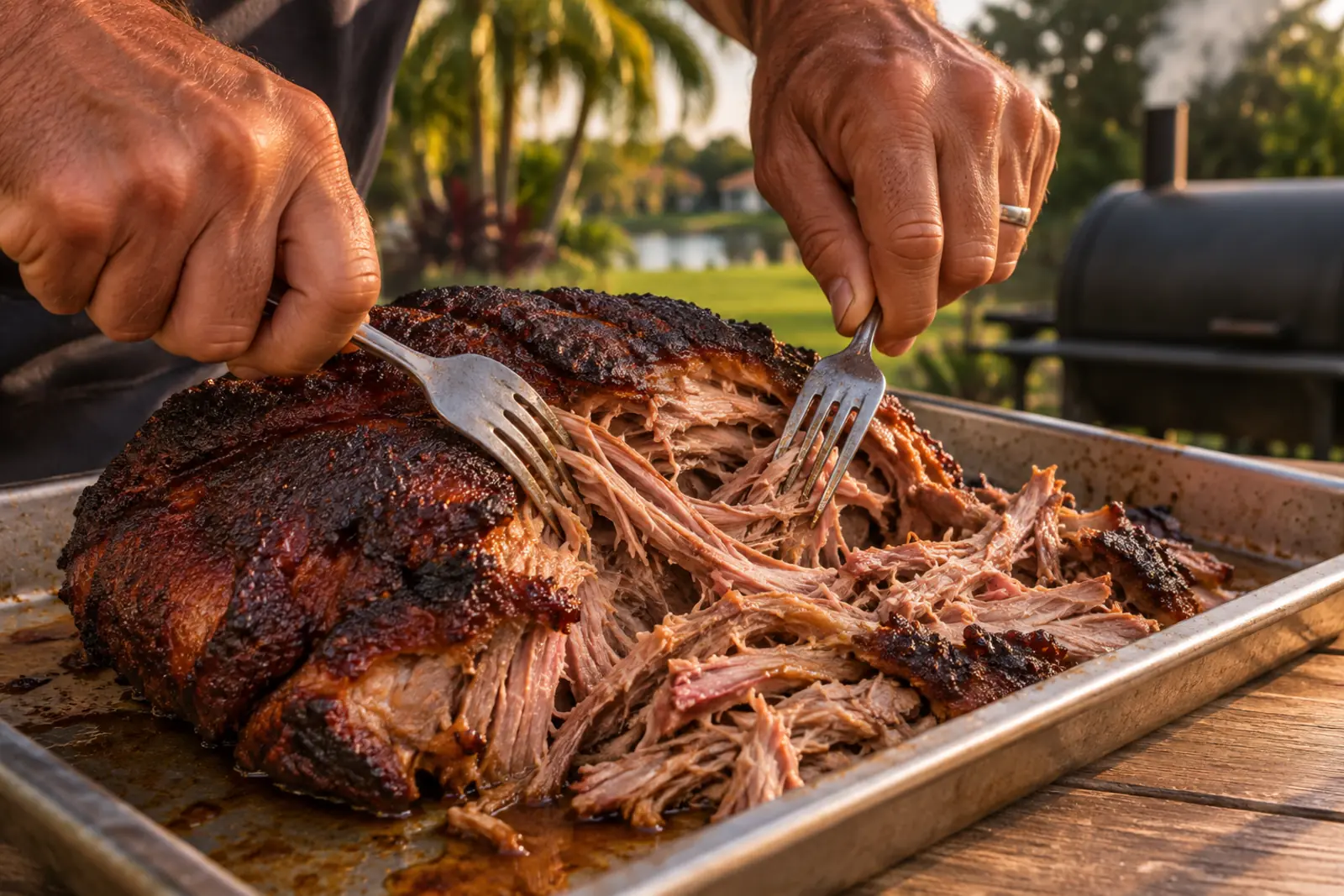
To smoke pulled pork, season a bone-in pork shoulder (often sold as a Boston butt), cook it with indirect heat and wood smoke at roughly 225°F to 275°F, and keep going until the internal temperature reaches about 195°F to 205°F and a probe slides in with almost no resistance. That usually takes somewhere around 1 to 2 hours per pound, so a typical 8-pound butt can need 10 to 14 hours plus resting time. Pork is safe to eat at 145°F with a 3-minute rest, according to USDA guidance, but it only becomes pullable at much higher temperatures, when its connective tissue has broken down.
This guide walks through how to smoke a pork shoulder from start to finish: the cut, the cook, the infamous stall, the finish and the timing. It applies to any smoker, from a kettle grill set up for indirect heat to a pellet cooker, and it has a short section on smoking pulled pork on a pellet grill.
The short version
- Buy a bone-in Boston butt of 7 to 9 pounds.
- Season it, then bring the smoker to 225°F to 275°F with thin, pale smoke.
- Cook it undisturbed until the bark sets, and expect the temperature to stall.
- Wrap it if you want to speed through the stall, or wait it out for a firmer bark.
- Pull it from the heat at about 195°F to 205°F, when the probe slides in with little resistance.
- Rest it for at least an hour, then shred.
Choosing the right pork shoulder cut
The pork shoulder is the front leg of the pig and is usually split into two pieces at the butcher counter. Pulled pork is almost always made from the Boston butt, the upper part of the shoulder.
| Cut | Also called | Notes for smoking |
|---|---|---|
| Boston butt | Pork butt, shoulder butt | Upper shoulder; well marbled, the classic pulled pork cut |
| Picnic shoulder | Picnic roast | Lower shoulder; more skin and bone, a little less uniform, often cheaper |
| Whole shoulder | Packer shoulder | Both pieces together; large, for big gatherings |
For a first cook, a bone-in Boston butt of 7 to 9 pounds is forgiving. The fat and collagen protect it from drying out, and the bone tells you when it is done, because it will wiggle loose.
What you need
- A smoker or a grill set up for indirect heat, with a lid.
- Hardwood chunks or pellets; see the guide to smoking woods for choices.
- Two thermometers if possible: one for the cooking chamber and one leave-in probe for the meat. Built-in lid gauges are often off by a wide margin.
- Butcher paper or heavy foil if you plan to wrap.
- Heat-resistant gloves, a large pan and two forks or meat claws for pulling.
- A cooler and old towels for resting the meat.
How to smoke pulled pork, step by step
- Trim lightly. Remove any loose flaps and hard, thick fat. Leave a thin layer on the fat cap. Pork butt does not need much trimming.
- Season. A simple rub works: salt, pepper, paprika, garlic powder and a little brown sugar. Some cooks apply a thin coat of yellow mustard first to help the rub stick. Season the night before and refrigerate if you can, or at least an hour before cooking.
- Stabilize the smoker. Bring it to 225°F to 275°F and let the fire settle until the smoke runs thin and pale blue, not thick and white. Thick white smoke tastes bitter.
- Cook fat side up or down. Opinions differ. Fat side toward the heat source shields the meat in smokers where heat comes from below.
- Leave it alone. Opening the lid releases heat and moisture. Check the fire and the thermometers, not the meat, for the first several hours.
- Spritz if you like. After the bark has set, usually three hours or more in, a light spray of apple juice, vinegar or water can help color and keep the surface from scorching. It is optional.
- Handle the stall. Expect the internal temperature to stop rising, often somewhere in the 150s to 160s °F, for hours. See the next section.
- Cook to tenderness. Start probing around 195°F. When the probe goes in like it is entering soft butter and the bone moves freely, it is ready.
- Rest. Wrap the shoulder, set it in a dry cooler with towels around it and rest at least an hour. Keep it at or above 140°F if it will sit for a long time before serving.
- Pull. Remove the bone, discard large pieces of fat and shred. Mix the dark bark through the lighter interior meat and season with a little of the juices or a vinegar sauce.
What internal temperature to pull pork shoulder
Pull the shoulder when the thickest part reads about 195°F to 205°F and the probe goes in with almost no resistance. Pulled pork reference sources such as Wikipedia's pulled pork entry give the same 195°F to 205°F window for meat that pulls apart properly. For the full table of safe and finishing temperatures for other cuts, see the BBQ temperature chart with cook times by meat.
The stall, explained
Partway through the cook, the meat's internal temperature plateaus and can stay flat for two to five hours or more. This is mostly evaporative cooling: moisture moving to the surface and evaporating takes heat away about as fast as the smoker adds it. It is normal, and it is the step that tempts beginners to crank the heat.
You have two options. Wait it out, which gives the firmest bark. Or wrap the meat tightly in butcher paper or foil once the bark has the color you want. Wrapping traps moisture, pushes the meat through the stall faster and softens the bark somewhat. Foil is faster and softer; butcher paper is a middle ground. Neither is wrong.
In Southwest Florida's humid air, the stall can behave differently from what recipes written in dry climates describe, so plan extra time. The page on smoking meat in heat, humidity and summer storms covers the weather side.
How to smoke pulled pork on a pellet grill
The method is the same on a pellet grill: a bone-in butt, a pit temperature between 225°F and 275°F, a probe in the meat and a pull at 195°F to 205°F. What changes is how the heat is managed. A pellet smoker feeds pellets from a hopper into a fire pot with an auger, and a temperature sensor in the cooking chamber tells a controller to adjust the pellet feed and fan speed to hold the set temperature, as described in Wikipedia's overview of smoking.
- Set it and watch the meat, not the fire. Because the controller holds the pit temperature, your main job is the leave-in probe and the stall.
- Check the controller against a second thermometer. The built-in sensor sits in one spot in the chamber, so a separate probe at grate level shows whether the number on the display matches what the meat is seeing.
- Choose pellets for flavor. Hardwood pellets burn clean; the smoking wood guide explains how fruit woods and hickory differ and which woods to avoid in Florida.
- Keep the hopper full for a long cook. A 10 to 14 hour cook can use a lot of pellets, so top up before you run low rather than during the stall.
- Protect the cooker from salt air and moisture. Electronics and hoppers do not like damp coastal conditions; see the guide to choosing a grill or smoker for a coastal climate.
Timing pulled pork for a gathering
Pork shoulder is notorious for finishing late. Work backward from the serving time and build in a cushion. A well-wrapped shoulder in a cooler holds heat for hours, so finishing early is much better than finishing late.
| Butt weight (raw) | Rough cook time at 225–275°F | Approximate cooked yield |
|---|---|---|
| 6 lb | 8–12 hours | about 3–3.5 lb |
| 8 lb | 10–14 hours | about 4–4.5 lb |
| 10 lb | 12–16 hours | about 5–5.5 lb |
These are rough planning figures. Pork shoulder commonly loses something like 40 to 50 percent of its raw weight to fat, bone and moisture. To scale this to a crowd, use the barbecue quantities per person page.
Food safety notes
- Thaw frozen shoulders in the refrigerator, which can take a day or more for a large piece.
- Do not partially cook pork and finish it later. Cook it through in one session.
- Keep finished pork hot (140°F or above) or cool it quickly. In hot weather, perishable food should not sit out more than an hour.
- Refrigerate leftovers in shallow containers within two hours, or one hour if it is above 90°F outside.
The time and temperature rules are covered in more depth in the barbecue food safety guide for hot weather.
Common mistakes
- Trusting the lid thermometer. Measure at grate level instead.
- Too much smoke. Wood is a seasoning. A clean fire with a few chunks is enough.
- Pulling at a number instead of by feel. Every shoulder is different. Tenderness is the test.
- Skipping the rest. Pulling immediately loses juice and burns fingers.
- Drowning it in sauce. Serve sauce on the side so people can choose.
Frequently Asked Questions
What temperature should pulled pork be when it is done?
Most cooks pull pork shoulder between about 195°F and 205°F, when a probe slides in with little resistance. It is safe at 145°F with a 3-minute rest under USDA guidance, but it will not shred until the connective tissue breaks down at higher temperatures. The BBQ temperature chart lists the numbers for other meats.
How long does it take to smoke a pork butt?
Plan on roughly 1 to 2 hours per pound at 225°F to 275°F, plus at least an hour of resting. An 8-pound butt often takes 10 to 14 hours, but the stall can stretch that, so build in extra time.
Should I wrap pork butt in foil or butcher paper?
Either works. Foil speeds the cook the most and softens the bark. Butcher paper lets some moisture escape, so it keeps a firmer bark while still helping you through the stall. You can also skip wrapping entirely and wait.
Can I smoke pulled pork the day before?
Yes. Cool it quickly in shallow containers, refrigerate it, and reheat it covered with a little of its juices until it is hot throughout, at least 165°F. This avoids a late-night cook and many people find the flavor holds up well.
Is Boston butt or picnic shoulder better for pulled pork?
Boston butt is the more common choice because it is well marbled and uniform. Picnic shoulder works too and is often cheaper, but it has more skin and bone, so you get a little less meat for the weight.