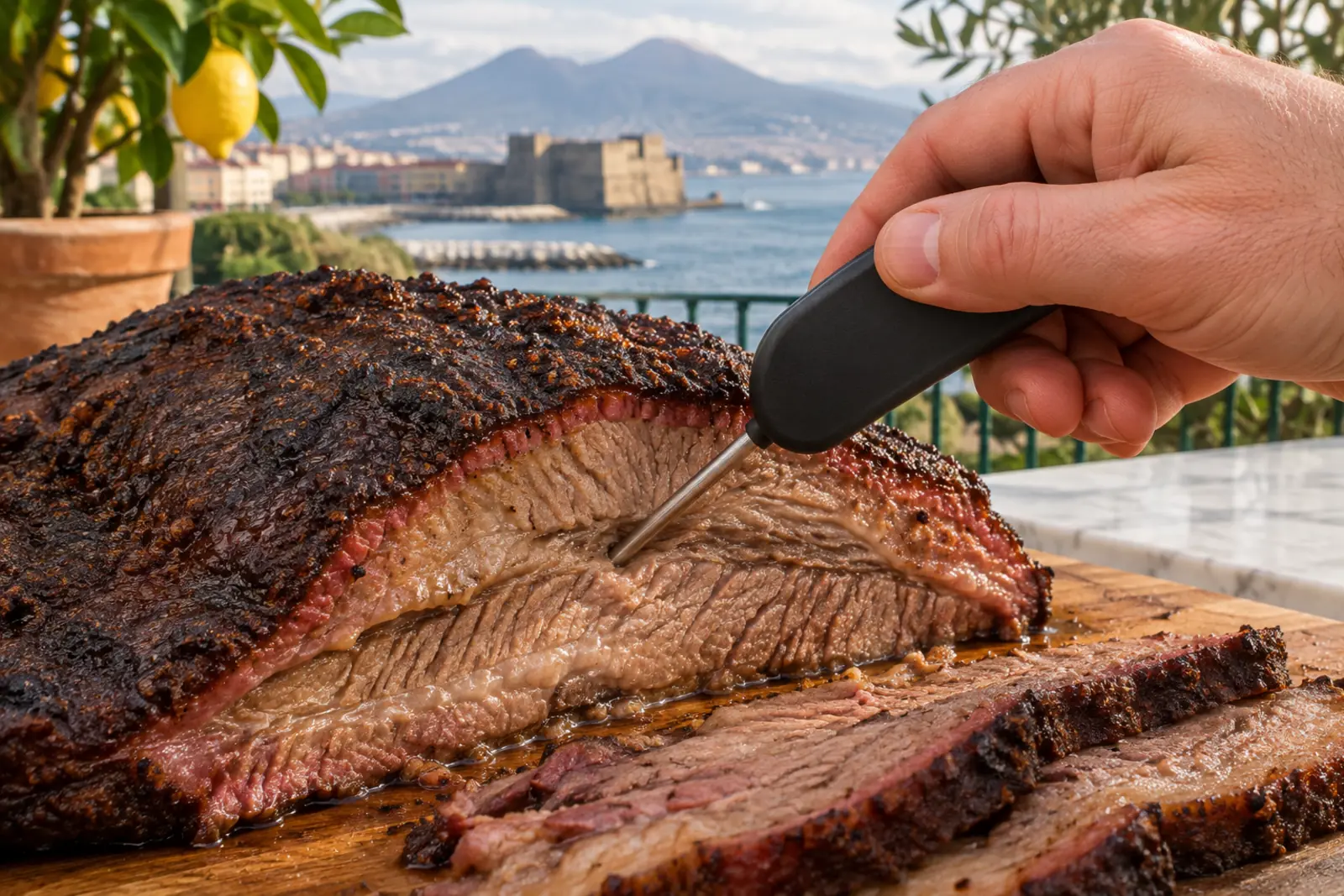
A BBQ temperature chart has to show two different sets of numbers: the temperature at which meat is safe to eat, and the temperature at which it becomes tender. USDA safe minimums are 145°F with a 3-minute rest for whole cuts of beef, pork, veal and lamb, 160°F for ground meats and sausage, 165°F for all poultry, and 145°F for fish. Tough barbecue cuts like brisket and pork shoulder are safe long before they are pleasant to eat, and most cooks take them to roughly 195°F to 205°F so the connective tissue melts. Ribs are judged by feel rather than a single number (the guide to smoking ribs covers the cook in full). The charts below put both sets of figures side by side.
The short version
- Brisket: pit at 225–275°F, finish around 195–205°F when a probe slides in like soft butter.
- Pork shoulder (pulled pork): pit at 225–275°F, finish around 195–205°F when the bone wiggles loose.
- Ribs: pit at 225–275°F, finish by the bend test, not by a number.
- Chicken: at least 165°F in the breast and thigh; thighs are often taken to 175–185°F for better texture.
- Fish: 145°F, or flesh that is opaque and flakes easily with a fork.
BBQ temperature chart: safe minimum internal temperatures
These figures come from the USDA's Food Safety and Inspection Service and the federal FoodSafety.gov temperature chart. Measure with a food thermometer in the thickest part, away from bone.
| Food | Safe minimum | Notes |
|---|---|---|
| Beef, pork, veal, lamb (steaks, chops, roasts) | 145°F | Rest at least 3 minutes |
| Ground beef, pork, veal, lamb; fresh sausage | 160°F | No rest required |
| Poultry (whole, parts, ground) | 165°F | Check the thigh and the thickest part of the breast |
| Fish (finfish) | 145°F | Flesh should be opaque and separate easily with a fork |
| Shrimp, lobster, crab | Judged by appearance | Cook until the flesh is pearly and opaque |
| Leftovers and reheated dishes | 165°F | Reheat until hot throughout |
BBQ meat temperature chart: targets for tenderness and cook times
The following are common cooking targets used by barbecue cooks, not safety rules. They vary with the size of the cut, the grade of the meat and the cook's taste.
| Cut | Typical pit temperature | Common finish point | Rough time |
|---|---|---|---|
| Beef brisket (whole packer) | 225–275°F | About 195–205°F, probe-tender | Often 10–16 hours |
| Pork shoulder / Boston butt | 225–275°F | About 195–205°F, bone wiggles loose | Roughly 1–2 hours per pound |
| Pork spare ribs (St. Louis cut) | 225–275°F | Bend test; meat pulls back from bone | About 5–6 hours |
| Pork baby back ribs | 225–275°F | Bend test | About 4–5 hours |
| Beef short ribs or plate ribs | 250–275°F | About 200–205°F, probe-tender | Often 7–10 hours |
| Whole chicken | 275–350°F | 165°F in breast and thigh | About 2–3 hours at lower pit temps |
| Chicken thighs | 275–350°F | Many cooks go to 175–185°F for texture | About 1–1.5 hours |
| Whole turkey breast | 275–325°F | 165°F | About 2–3 hours |
| Fish fillets (hot smoked) | 180–225°F | 145°F | About 1–3 hours depending on thickness |
Times are planning estimates. Wind, humidity, how often the lid opens and the individual piece of meat can all push a cook longer than expected. On a humid Naples afternoon a cook can run slow even when the thermometer says the smoker is on target; the guide to smoking meat in heat, humidity and summer storms covers how to plan for that.
Working backwards from serving time? Start the cook early and plan for a long rest rather than a rushed finish, since a brisket or pork shoulder that is done early can be held, while one that is done late cannot. If you are still deciding how much meat to cook, the BBQ per person guide turns a guest count into pounds of raw meat.
Brisket internal temp and pork shoulder internal temp
Brisket
A whole packer brisket is safe at 145°F, but at that point it is still tough. Most cooks pull it when the thickest part of the flat is around 195°F to 205°F and a probe goes in with almost no resistance. Check the flat and the point separately, because they finish at different rates.
Pork shoulder
Pork shoulder follows the same pattern: safe long before it is pullable. The usual finish point is about 195°F to 205°F, when the shoulder blade bone wiggles loose. The step-by-step pulled pork guide walks through the full cook, wrap and rest.
Why tough cuts need higher temperatures
Brisket and pork shoulder are working muscles full of collagen. At typical steak temperatures, collagen stays tough and chewy. Held for hours in the 160°F to 205°F range, it gradually breaks down into gelatin, which is what gives smoked meat its moist, tender texture. Lean cuts like pork tenderloin or chicken breast have little collagen, so cooking them that long only dries them out. That is why the chart above treats them so differently.
How to measure correctly
- Use an instant-read or leave-in probe thermometer. Color, juices and cooking time are unreliable indicators of safety.
- Check the thickest part. Avoid bone, fat pockets and gristle, which read differently.
- Probe in more than one spot. A brisket flat and point finish at different rates.
- Calibrate now and then. In a glass of ice water stirred well, a thermometer should read close to 32°F.
- Measure pit temperature at grate level. Lid-mounted dials can read far from what the meat experiences.
Reading tenderness: the probe and bend tests
The probe test
For brisket, pork shoulder and beef ribs, slide a thermometer probe or skewer into the meat in several places. When it meets almost no resistance, as though entering soft butter, the meat is done, whatever the number says. A brisket may feel ready at 198°F or need 208°F.
The bend test for ribs
Pick up a rack with tongs about a third of the way from one end. If it bends easily and the surface starts to crack, it is ready. If it stays stiff, it needs more time. Fall-off-the-bone ribs are a preference, not a standard; competition-style ribs leave a clean bite mark but stay on the bone.
Carryover cooking and resting
Large cuts keep cooking after they leave the heat, sometimes rising several degrees. Resting also lets juices redistribute. Brisket and pork shoulder benefit from a rest of at least an hour wrapped in paper or foil inside an empty cooler. If meat will be held longer before serving, keep it at 140°F or above, then slice or pull it just before eating.
Thermometers worth having
| Type | Best for | Limitations |
|---|---|---|
| Instant-read digital | Spot checks, chicken, ribs, fish | Must open the lid to use |
| Leave-in probe with display | Long cooks like brisket and pork butt | Cables can be damaged by heat or pinched lids |
| Wireless probe | Monitoring from indoors during storms or heat | Range and battery life vary |
| Grate-level pit probe | Knowing the real cooking temperature | Needs a clip or stand to avoid touching grates |
Once the meat is cooked, holding and serving it safely matters just as much. Read the guide to barbecue food safety in Florida heat before serving outdoors, and see the grill and smoker buying guide if you are still picking equipment. A wireless probe is also the practical choice when a storm is coming; see grilling during hurricane season and power outages. For a Florida fish example, see the smoked mullet guide.
Frequently Asked Questions
What temperature is brisket done?
Brisket is safe at 145°F with a rest, but most cooks finish it around 195°F to 205°F, when a probe slides in with little resistance. Tenderness, not a single number, is the real test.
Is pork safe at 145 degrees?
Yes. USDA guidance says whole cuts of pork are safe at 145°F followed by a 3-minute rest. Ground pork and sausage need 160°F. Pork shoulder for pulling is cooked much higher for texture, not safety.
Why does chicken need 165°F?
USDA sets 165°F for all poultry to make sure harmful bacteria such as Salmonella are destroyed. Dark meat like thighs is often cooked higher, around 175°F to 185°F, because it becomes more tender.
How do I know when ribs are done without a thermometer?
Use the bend test. Lift the rack with tongs near one end; if it bends easily and the surface begins to crack, it is ready. The meat should also have pulled back from the ends of the bones.
Can I trust the thermometer built into my grill lid?
Treat it as a rough guide. Lid thermometers sit above the cooking surface and are often off by a significant amount. A separate probe placed at grate level gives a far more accurate reading.