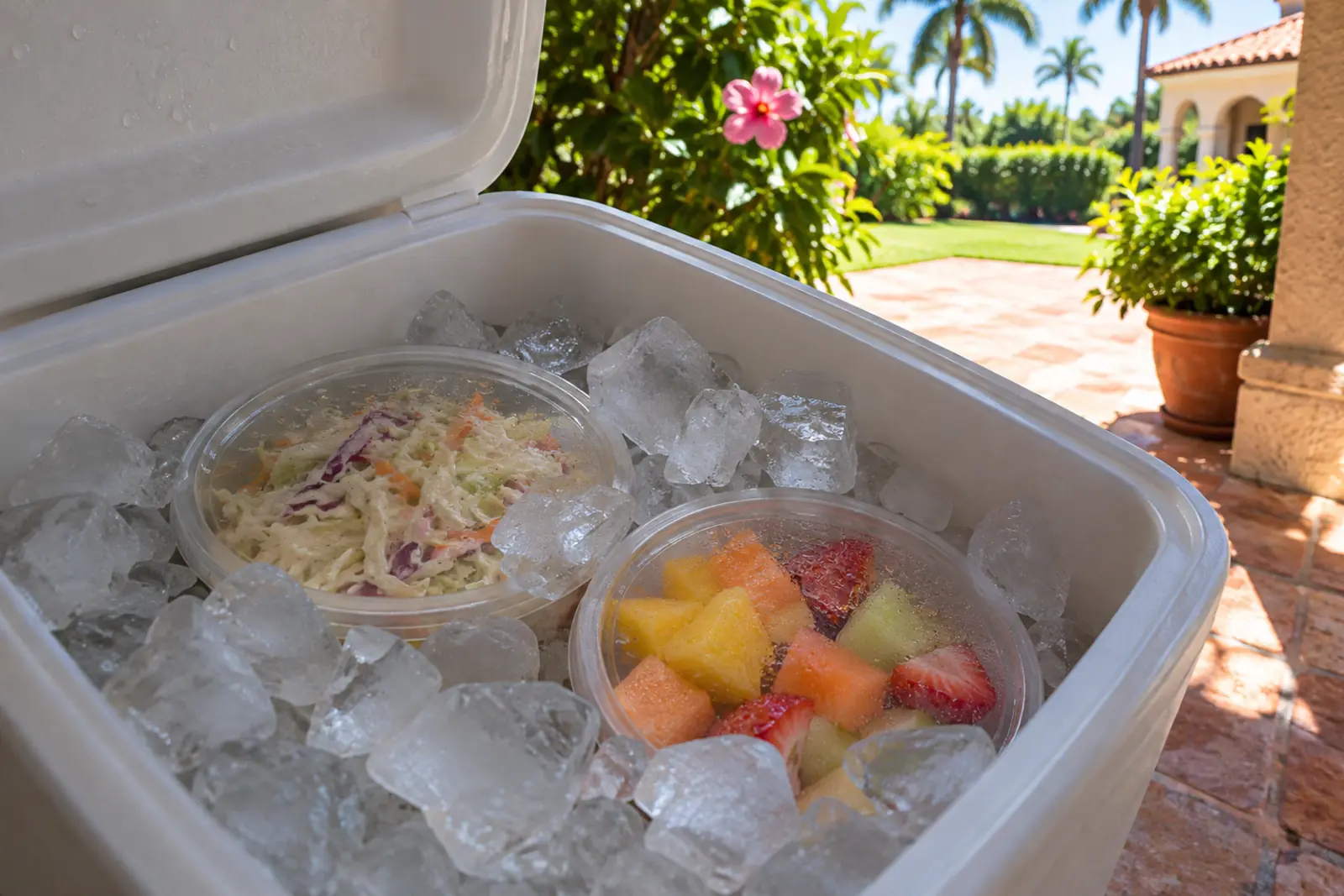
The core rule for barbecue food safety in hot weather is time and temperature. Bacteria multiply fastest between 40°F and 140°F, the range the USDA calls the danger zone. Keep cold food at 40°F or below and hot food at 140°F or above, cook meat to its safe minimum internal temperature, and never leave perishable food out more than two hours, or more than one hour when the air temperature is above 90°F. In Naples, typical afternoon highs sit near or around 90°F from late spring into early fall, and a sunny patio or beach can feel hotter, so for outdoor cookouts in those months the one-hour limit is the one to plan around.
The numbers to remember
| Rule | Figure |
|---|---|
| Danger zone | 40°F to 140°F |
| Cold holding | 40°F or below |
| Hot holding | 140°F or above |
| Maximum time out (normal conditions) | 2 hours |
| Maximum time out above 90°F | 1 hour |
| Poultry, cooked | 165°F |
| Ground meat and sausage, cooked | 160°F |
| Whole cuts of beef, pork, lamb, cooked | 145°F plus a 3-minute rest |
| Fish, cooked | 145°F |
| Reheating leftovers | 165°F |
These figures follow guidance from the USDA Food Safety and Inspection Service. For more detail, see the USDA page on the danger zone. The temperature and cook time chart lays out the safe minimums next to the tenderness targets used for barbecue.
Why heat changes the rules
The two-hour limit assumes ordinary room conditions. Above 90°F, food warms into the danger zone faster and stays there, so the CDC and USDA both shorten the limit to one hour for perishable food exposed to heat, such as a picnic table or a hot car.
Barbecue is also a classic setting for Clostridium perfringens. The CDC lists poultry, beef, pork and gravy among the foods involved, particularly food cooked in large batches and held at unsafe temperatures, and estimates almost 900,000 U.S. cases a year. That describes a big pan of pulled pork or brisket kept lukewarm on a buffet, which is why holding temperature matters as much as cooking temperature.
Before the cook: shopping, thawing and marinating
- Shop last. Pick up meat at the end of your trip and get it into a refrigerator or a cooler with ice quickly. A car parked in Florida sun heats up fast.
- Thaw safely. Thaw in the refrigerator, in cold water changed every 30 minutes, or in the microwave if you will cook immediately. Do not thaw meat on the counter or in the sun.
- Marinate in the refrigerator. Not on the counter or outdoors.
- Do not reuse raw marinade as a sauce unless you bring it to a boil first. Better yet, set some aside before it touches raw meat.
- Skip washing raw chicken. The CDC says raw chicken does not need to be washed first, because rinsing can spread germs to the sink, counter and other food.
- Check your refrigerator. The CDC recommends keeping the refrigerator at 40°F or below and the freezer at 0°F or below.
Packing coolers for a Florida cookout
- Use separate coolers for drinks and for perishable food. The drink cooler gets opened constantly and warms up.
- Pack raw meat frozen or well chilled, sealed, at the bottom where it cannot drip onto other foods.
- Fill empty space with ice or frozen gel packs. A full cooler stays cold longer than a half-empty one.
- Keep coolers in shade, off hot sand or pavement, and covered with a towel or blanket.
- Put an appliance thermometer inside the food cooler so you can check that it stays at 40°F or below.
- Open the food cooler only when you need something, and close it right away. If the thermometer reads above 40°F, start the one-hour clock for what is inside.
During the cook
- Separate raw and cooked. Use a clean platter and clean utensils for cooked food. Never put cooked meat back on the plate that held raw meat.
- Wash hands. The CDC advises at least 20 seconds with soap and water. Bring soap and water, or at least moist towelettes and hand sanitizer, if you are away from a sink.
- Do not partially cook and finish later. If you precook meat in a kitchen to shorten grill time, move it to the grill immediately.
- Use a thermometer. Grill marks and color do not tell you whether meat is safe. A burger can brown before it reaches 160°F. The CDC calls a food thermometer the reliable check for everything except seafood, where opaque, flaky flesh is also a sign.
- Keep cooked meat hot. Move it to the side of the grill away from the coals, or into a warm oven or an insulated cooler wrapped in foil, so it stays at 140°F or above.
Long smokes add their own heat and humidity issues, covered in the guide to smoking meat in Florida heat, humidity and summer storms.
Serving outdoors in heat
Buffets and picnic tables are where most mistakes happen. Food is set out, people come and go, and nobody watches the clock.
| Food type | How to keep it safe outdoors |
|---|---|
| Smoked or grilled meat | Hold in a warming tray, chafing dish or insulated cooler at 140°F or above; bring out in small batches |
| Mayonnaise-based salads, slaw | Nest the serving bowl in a larger bowl of ice; replace rather than top up |
| Cut fruit and vegetables | Keep on ice; cut produce is perishable |
| Dips, including smoked fish dip | Serve small portions over ice and swap them out often |
| Baked beans, mac and cheese | Keep hot in a slow cooker or chafing dish |
Set a timer when food goes out. When the hour is up in 90°F-plus weather, perishable food that has been sitting in the danger zone should be thrown away. When in doubt, throw it out. If you serve smoked fish dip, the smoked mullet and fish dip guide covers keeping it cold.
Hosting a larger event and weighing whether to hire it out? The guide to choosing BBQ catering in Naples covers what to check before booking; ask any caterer how they hold food at 140°F or above.
Leftovers
- Refrigerate leftovers within two hours of cooking, or within one hour if it is above 90°F outside.
- Divide large amounts, like a whole pork shoulder or brisket, into shallow containers so they cool quickly. The CDC gives the same advice for warm food generally.
- Use refrigerated leftovers within about three to four days, or freeze them.
- Reheat to 165°F until hot throughout. In a microwave, check that the food actually reaches 165°F, since microwaves heat unevenly.
For what to do with a whole shoulder at the end of a long cook, see the step-by-step pulled pork guide.
Who is most at risk
Foodborne illness can be especially serious for older adults, young children, pregnant people and anyone with a weakened immune system. Naples has a large population of older residents, so at many local gatherings it is worth being stricter than the minimum. If you are cooking for a crowd, use the portion planning in the barbecue per person guide so you are not tempted to leave extra food out for hours.
Storms and outages
Summer thunderstorms and hurricane season can knock out power in the middle of a cookout or while food is chilling. Refrigerator and freezer holding times, and what to keep or throw away afterward, are covered in the hurricane season grilling guide. The heat rules above still apply to anything that is out of a working refrigerator or cooler.
Frequently Asked Questions
How long can barbecue sit out in Florida heat?
No more than one hour when the outdoor temperature is above 90°F, and no more than two hours in cooler weather. After that, perishable food that has been in the danger zone should be discarded.
What is the food danger zone?
The USDA's term for the range between 40°F and 140°F, where bacteria can multiply rapidly. Keep cold food at 40°F or below and hot food at 140°F or above.
Can I use leftover marinade as a sauce?
Only if you bring it to a boil first to destroy bacteria from the raw meat. A simpler approach is to set aside a portion of fresh marinade before it touches any raw meat.
Is it safe to partially grill meat and finish it later?
No. Partial cooking can leave bacteria alive and warm, which lets them grow. If you precook meat to speed things up, put it on the grill right away and cook it to a safe temperature.
How should I keep potato salad and slaw safe at an outdoor party?
Keep them at 40°F or below by setting the serving bowl in a larger bowl of ice, serve small amounts, and replace them rather than adding fresh food to a bowl that has been sitting out.