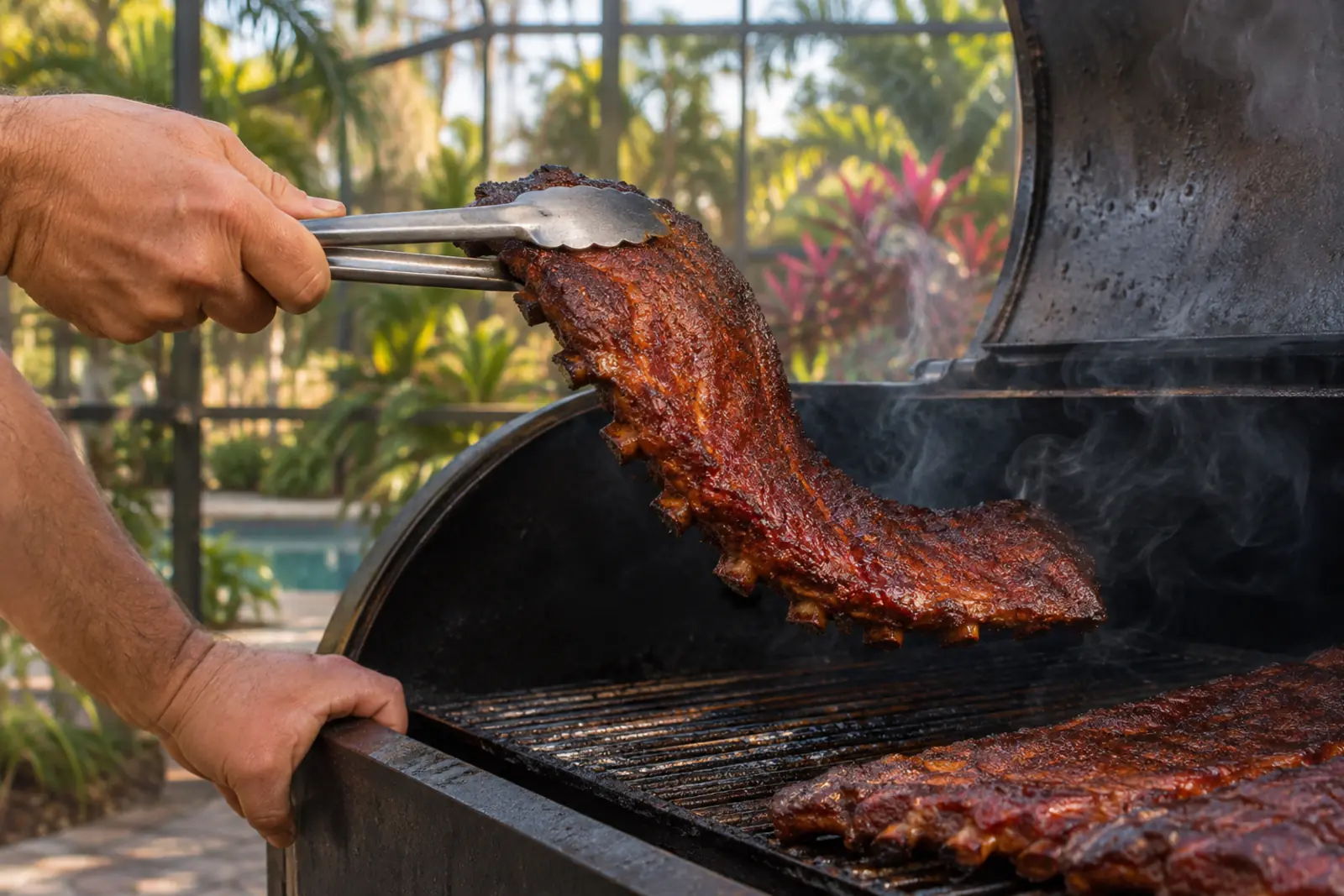
To smoke ribs, season a rack of pork ribs, cook it with indirect heat and wood smoke at 225°F to 275°F, and take it off when it passes the bend test and a probe slides between the bones with little resistance. Expect roughly 4 to 6 hours for baby backs and 5 to 7 hours for spare ribs or St. Louis cut at the low end of that temperature range. Pork is safe at 145°F with a 3-minute rest under USDA guidance, but ribs are judged by tenderness, not by that number.
This guide covers what to buy, how to prepare the rack, how to hold the smoker steady, the 3-2-1 method and its shortcuts, and how to tell when ribs are done. It works on a pellet grill, a charcoal smoker or a gas grill set up for indirect heat, and it comes with notes for cooking in Southwest Florida's humid weather.
The short version
- Buy St. Louis cut spare ribs or baby backs and pat them dry.
- Peel the membrane from the bone side and trim loose flaps.
- Season with a simple rub, then bring the smoker to 225°F to 275°F with thin, pale smoke.
- Cook meat side up, undisturbed, until the bark sets.
- Wrap if you want faster, softer ribs; skip the wrap for a firmer bite.
- Test with the bend test and a probe, then rest 10 to 15 minutes before cutting.
Spare ribs, St. Louis cut and baby back ribs: what to buy
Baby back ribs come from the loin, along the top of the rib cage, while spare ribs come from the belly side. St. Louis cut is a spare rib rack trimmed into a neat rectangle by removing the sternum, cartilage and rib tips, according to Wikipedia's entry on St. Louis-style barbecue.
| Cut | Size and fat | Typical time at 225°F | Notes |
|---|---|---|---|
| Baby back ribs | Smaller, leaner, curved | About 4.5 to 6 hours | Cook faster and dry out sooner, so they suit a shorter wrap |
| Spare ribs (full) | Larger, fattier, with tips | About 5 to 7 hours | More meat and flavor; trim or cook the tips separately |
| St. Louis cut | Even rectangle, fatty | About 5 to 6 hours | Easiest to cook evenly and to portion |
Times are planning estimates drawn from the ranges most barbecue guides give, not guarantees. The same ranges, with the tenderness cues, appear in the BBQ temperature chart with cook times by meat.
Trimming and seasoning
Pat the rack dry. On the bone side, slide a butter knife under the thin membrane at one end, grip the loosened edge with a paper towel and pull it off in one piece. It blocks smoke and rub and turns leathery when cooked. Trim any hanging flaps and thick fat pockets, but leave the surface fat that bastes the meat.
A basic rub is salt, black pepper, paprika, garlic powder and a little brown sugar. Salt for at least an hour, or overnight in the refrigerator, so it can season the meat. A thin coat of yellow mustard is optional and only helps the rub stick. Go easy on sugar in a hot smoker, since it can scorch above about 275°F.
Smoker temperature and wood for ribs
Hold the smoker between 225°F and 275°F. The low end gives more smoke exposure and a longer cook; around 250°F to 275°F is a common compromise when time matters. Use a probe in the cooking chamber at grate level, because built-in lid gauges can be well off.
Ribs take smoke quickly, so use a moderate amount of a mild to medium wood. Apple, cherry, oak and pecan are common choices, and hickory works in smaller doses; the guide to the best wood for smoking meat explains how each burns and which Florida woods never to use.
The 3-2-1 method, and when to skip it
The 3-2-1 method splits the cook into three stages at about 225°F: 3 hours unwrapped in smoke, 2 hours wrapped in foil with a splash of liquid, then 1 hour unwrapped, often with sauce. It suits full spare ribs and St. Louis cut, and it produces very soft, fall-off-the-bone meat.
Baby backs are smaller, so a rigid 3-2-1 tends to overcook them; a 2-2-1 schedule is the usual adjustment. Many cooks skip the wrap entirely and smoke the rack for the whole time, which keeps a chewier bark and a cleaner bite. Fall-off-the-bone is a preference, not a standard, as the temperature chart guide also notes.
How to tell ribs are done
The bend test
Lift the rack with tongs about a third of the way from one end. If it bends deeply and the surface cracks, it is ready. A stiff rack needs more time.
The probe test and temperature
Slide a thin probe between two bones. It should go in with almost no resistance. Between the bones, ribs often read somewhere in the mid 190s to about 205°F when tender, but the feel matters more than the number. Meat pulling back a quarter inch or so from the bone ends is another cue.
For safety, check that the thickest meat reaches at least 145°F; the USDA Food Safety and Inspection Service temperature chart lists 145°F with a 3-minute rest for pork roasts, chops and steaks. Ribs almost always pass that long before they are tender.
Smoking ribs on pellet, charcoal and gas grills
- Pellet grill: set the target temperature and let the controller feed pellets. Smoke is lighter at higher settings, so many cooks start at 225°F for the first hours.
- Charcoal smoker or kettle: bank the coals to one side, add wood chunks, and keep the ribs over the cool side. Watch vents to hold temperature, and top up fuel before it runs low.
- Gas grill: light one burner on low, put a smoker box or foil packet of wood chips over it, and cook the ribs on the unlit side. Gas grills reach smoky flavor less easily, so a wrap helps hold moisture.
The coastal grill and smoker guide covers choosing a cooker for salt air.
Resting, slicing and cooking in Florida weather
Rest the rack, loosely tented, for 10 to 15 minutes, then slice between the bones with a sharp knife. Brush on sauce in the last 15 to 20 minutes or at the table so the sugars do not burn.
Humidity, wind and sudden storms can stretch a cook. Start earlier than the clock suggests and plan for a hold; ribs kept hot at 140°F or higher stay safe and moist for a while in foil. The guides to smoking in heat, humidity and rain and BBQ food safety in hot weather cover the details. For a longer cook with a shoulder, see how to smoke pulled pork.
Frequently Asked Questions
How long does it take to smoke ribs at 225°F?
Baby backs generally take about 4.5 to 6 hours, and St. Louis cut or spare ribs about 5 to 7 hours. Rack thickness, wrapping and weather change the timing, so rely on the bend and probe tests rather than the clock.
Do I need to wrap ribs in foil?
No. Wrapping, as in the 3-2-1 method, makes ribs softer and shortens the cook. Unwrapped ribs keep a firmer bark and chewier bite. Both are valid; it depends on the texture you want.
What internal temperature are ribs done?
Ribs are safe at 145°F with a 3-minute rest, but they usually become tender in the mid 190s to around 205°F. A bend test and a probe sliding between the bones are more reliable than the number alone.
Should I remove the membrane from ribs?
Most cooks do. The thin membrane on the bone side blocks smoke and rub and can be tough after cooking, so peeling it off with a paper towel gives a better bite.
Can I smoke ribs on a gas grill?
Yes. Light one burner on low, put wood chips in a smoker box or foil packet over it, and cook the ribs on the unlit side at about 225°F to 275°F. Wrapping partway helps keep them moist.